
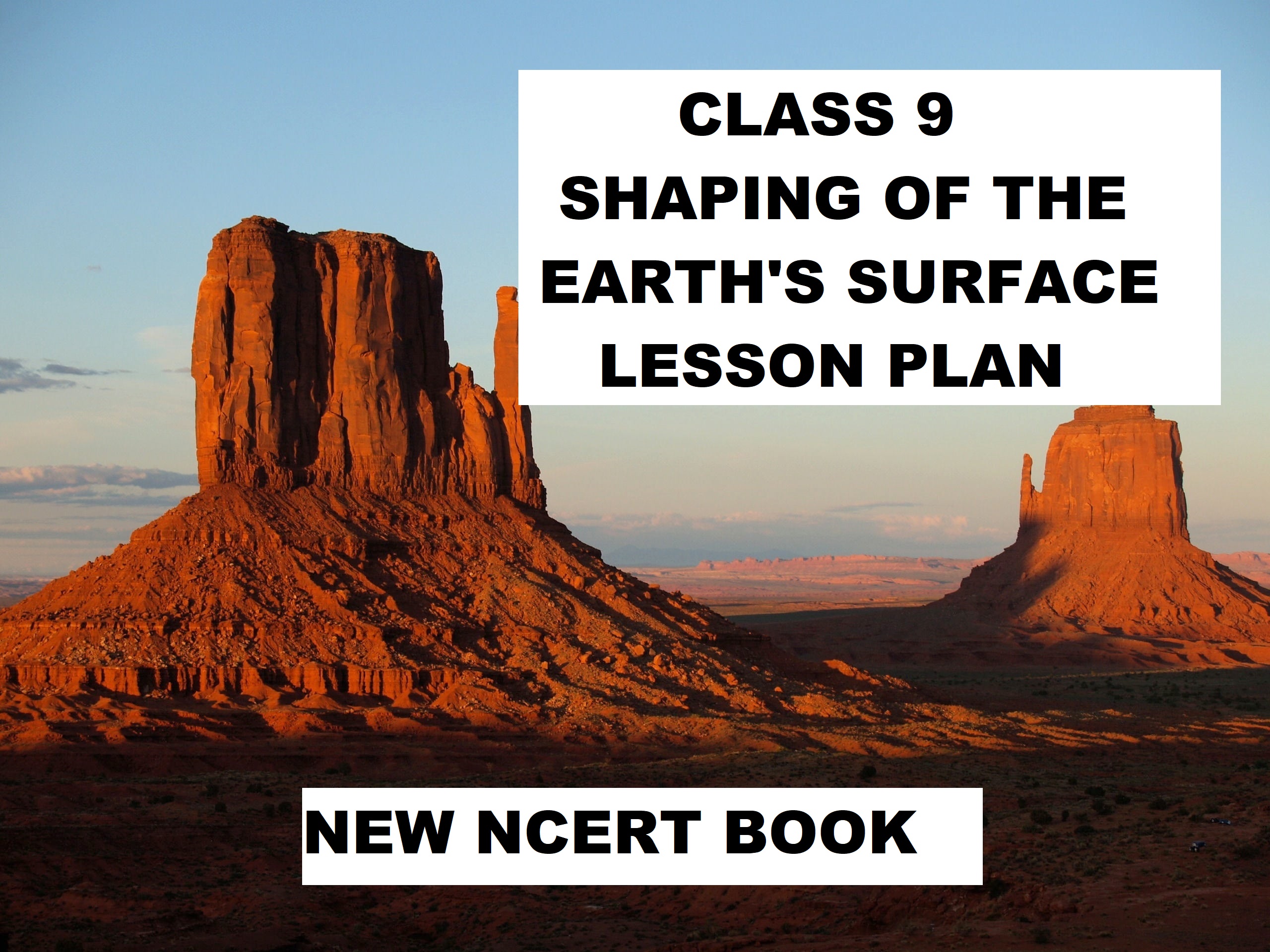

Shaping of the Earth’s Surface Lesson Plan
The “Shaping of the Earth’s Surface” lesson plan is designed primarily for new Social Science teachers, especially those teaching Class 9. It includes all essential components of a well-structured lesson plan such as:
- General objectives
- Teaching points
- Activities
- Class tests
- Learning outcomes
This lesson plan is created to meet the needs of both students and teachers, offering a comprehensive guide for effective teaching. It is intended to be a useful and helpful resource for delivering the topic of the Earth’s surface shaping.
Shaping of the Earth’s Surface Lesson Plan
Date: 26/06/2026
Class: IX
Subject: Social Science (Geography)
Duration: 40–45 Minutes
Learning Objectives
The purpose of teaching the chapter “Shaping of the Earth’s surface” is to know about the basics of Geography. By the end of the lesson, students will be able to:
- Explain the meaning of landforms and the processes involved in the shaping of the Earth’s surface.
- Differentiate between endogenic and exogenic forces.
- identify the role of rivers, glaciers, wind and sea waves in creating new landforms.
- Describe the formation of major landforms such as mountains, plains, sand dunes, etc.
- Relate geographical processes to examples from current environmental issues.
Shaping of the Earth’s Surface Lesson Plan
Teaching Aids
- NCERT Textbook. (if available)
- Physical map of India
- Globe
- Charts and diagrams
- Smart board
Digital Teaching Aids
- Educational videos on erosion and deposition
- Google Earth images
- Interactive geographical animations
Materials for Activities
- Sand tray
- Water bottle
- Clay
- Worksheets
Teaching Points
The following teaching points will be discussed and explained during the course of teaching.
- The Continental Drift Theory.
- The theory of Plate Tectonics.
- Introduction to Landforms
- Dynamic nature of the Earth’s surface
- Internal Forces (Endogenic Forces)
- External Forces (Exogenic Forces)
- Agents Shaping the Earth’s Surface
- Landforms created by Different Agents
- Disaster Management – GLOF
Pedagogical Strategies
The teacher while teaching the chapter “Shaping of the Earth’s surface” will adopt the following Pedagogical strategies.
This will make the chapter interesting and alive.
Inquiry-Based Learning:
Before the start of the chapter, the teacher will ask the following questions:
- Why do mountains, valleys, and plains look different?
- Can the Earth’s surface change over time?
Interactive Discussion
The teacher also uses the interactive method to explain the complicated concepts such as continental Drift, Endogenic and Exogenic forces etc.
Demonstration Method
In due course of time, the teacher uses the demonstration method to explain erosion and deposition with the help of diagrams, videos, and models.
Collaborative Learning
The teacher also conducts Group discussion on various agents shaping landforms.
Experiential Learning
Further, the teacher asks the students to observe the nearby hills, rivers, and soil erosion areas.
Visual Learning
Lastly, the teacher uses visual pictures such as Maps, photographs, and, diagrams of landforms to check their understanding about the landforms.
Shaping of the Earth’s Surface Lesson Plan
Interdisciplinary Linkages
| Subject | Linkage |
|---|---|
| Science | Weathering, rock cycle, earthquakes, volcanoes |
| Mathematics | Measurement of height, slope, and distance |
| Environmental Studies | Soil conservation and environmental management |
| Art | Drawing and modeling landforms |
| Information Technology | Digital maps and satellite imagery |
Classroom Activities
Activity 1: River Erosion Demonstration
Procedure
- Create a small sand model.
- Pour water slowly over the sand.
- Observe channels and deposition patterns.
Learning
Students understand erosion and deposition by rivers.
Activity 2: Landform Identification
Show pictures of:
- Mountains
- Valleys
- Deltas
- Sand dunes
- Sea arches
Students identify:
- Name of landform
- Agent responsible for its formation
Activity 3: Think-Pair-Share
Question:
“How might climate change influence the shaping of the Earth’s surface?”
Students discuss and share ideas.
Activity 4: Concept Mapping
Students prepare a flowchart:
Earth’s Surface
↓
Internal Forces → Mountains, Plateaus
External Forces → Valleys, Deltas, Dunes
8. Assignments Planned
Home Assignment
A. Short Answer Questions
- What are endogenic forces?
- Name any three agents of erosion.
- How is a delta formed?
- What is weathering?
B. Observation Task
Observe your locality and identify any signs of erosion, deposition, or weathering. Write a short note (100 words).
Project Work
Prepare a chart/model showing:
- River landforms
- Wind landforms
- Glacial landforms
- Coastal landforms
with suitable pictures and labels.
Assessment Tools
A. Diagnostic Assessment
- Oral questions based on prior knowledge:
- What is a mountain?
- Have you seen a river changing its course?
B. Formative Assessment
Observation Checklist
| Criteria | Yes | No |
|---|---|---|
| Participates in discussion | ||
| Identifies landforms correctly | ||
| Contributes to group work | ||
| Uses geographical terms accurately |
C. Quiz Questions
- Which force originates inside the Earth?
- (a) River action
- (b) Wind action
- (c) Endogenic force
- (d) Sea wave action
- Sand dunes are formed by:
- (a) Rivers
- (b) Wind
- (c) Glaciers
- (d) Volcanoes
- A delta is formed due to:
- (a) Deposition by rivers
- (b) Volcanic eruption
- (c) Wind erosion
- (d) Earthquakes
D. Rubric-Based Assessment
| Criteria | Excellent (3) | Good (2) | Needs Improvement (1) |
|---|---|---|---|
| Concept Understanding | Accurate and detailed | Mostly correct | Limited understanding |
| Participation | Highly active | Moderately active | Passive |
| Activity Performance | Completes independently | Requires guidance | Unable to complete |
| Assignment Quality | Well-organized and creative | Satisfactory | Incomplete |
Learning Outcomes
After the completion of the chapter, the Students will be able to:
- Define endogenic and exogenic forces.
- Explain how natural agents continuously modify the Earth’s surface.
- Classify landforms according to their mode of formation.
- Interpret diagrams and photographs of landforms.
- Appreciate the dynamic nature of the Earth’s crust and environmental changes.
Conclusion
Summarize that the Earth’s surface is continuously changing due to internal forces (earth movements and volcanoes) and external forces (rivers, wind, glaciers, and sea waves). Emphasize that these processes create and modify the landforms we see around us, making the Earth a dynamic planet.
The lesson on Shaping of the Earth’s Surface enables students to understand that the Earth’s surface is dynamic and continuously changing due to the action of internal and external forces. Through interactive discussions, maps, diagrams, activities, and real-life examples, students develop a clear understanding of how landforms such as mountains, plateaus, plains, valleys, and river basins are formed over time. This lesson also encourages scientific thinking, observation, and environmental awareness by helping learners relate geographical processes to their surroundings. The activities and assessments included in the lesson promote critical thinking, teamwork, and problem-solving skills while catering to diverse learning needs.
By the end of the lesson, students are expected to confidently explain the processes responsible for shaping the Earth’s surface and appreciate the continuous interaction between nature and human life. Overall, this lesson builds a strong foundation for understanding physical geography and prepares students for advanced geographical concepts in higher classes.
Do comment about the lesson plan. Pl. comment and subscribe for more such detailed lesson plans.




0 Comments