
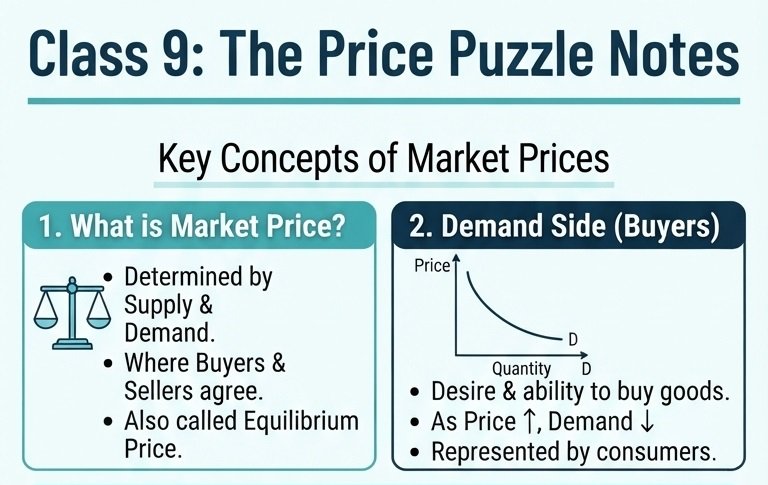

The Price Puzzle Class 9 Economics Notes
The Price Puzzle Class 9 Economics Notes will help you understand the chapter easily. Do you know why the price of vegetables changes in the market? Who decides whether the price is likely to increase or decrease? Why is the price of a product lower when many shops have the same product? The market is driven by two primary forces: Demand and Supply.
Let us study the chapter to understand all about the market. A market is a place where goods and services are exchanged between buyers and sellers. Buyers want to buy at lower prices, and sellers want to sell at higher prices to make more money.
Through this chapter, “The Price Puzzle – What Drives the Market,” you will learn how markets work, why prices change, and how buyers and sellers respond to these changes in everyday life. Check out the notes related to Building Blocks in Economics.
What is Demand?
The quantity of a product that people are willing and able to buy at a particular price is called the demand for the product.
Demand is not just the desire to buy something; it is the willingness complemented by the ability or purchasing power to buy it.
What is the Law of Demand?
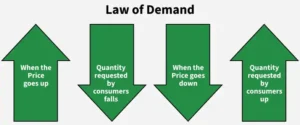
The Law of Demand says that if the price of a product goes up, the amount demanded will fall, but if the price goes down, then the quantity demanded will rise.
It illustrates an inverse relationship between the price of a product or service and the quantity demanded.
The inverse relationship between the price of a product or service and the quantity demanded. Individual Demand
Individual Demand
Individual demand refers to the amount of a good or service that a consumer is willing to purchase at various prices, with all other factors remaining the
same.
The amount of a good or service that a single consumer is willing and able to purchase at various prices, all other things remaining the same, is defined as
individual demand.
An individual’s demand is shown in the demand schedule, and the demand curve is what the schedule looks like when put into graphical form. Example:
Understanding Individual Demand
Take the case of Srivalli, who is buying mangoes when the mango season is ongoing.
At the start of the season, the price of mangoes was ₹150 per kg.
Because the price was high, she bought only 1 kg of mangoes.
When more mangoes became available in the market, the price dropped to ₹100 per kg and at this lower price she increased her purchase to 2 kg.
When the price later dropped to fifty rupees per kg she took and bought three kilograms of mangoes.
It shows that when the price of mangoes fell, the quantity demanded rose, which is an example of the Law of Demand.
The ‘demand schedule’ is a table that represents the individual demand as below:
| Price of Mangoes (in Rs.) (Per Kg) | Quantity Demanded by a customer |
| 150 | 1 kg |
| 100 | 2 kgs. |
| 50 | 3 kgs. |
Individual demand schedule (a) and Individual demand curve (b)
When this demand schedule is plotted on a graph, it is called a ‘demand curve’.
The Price Puzzle Class 9 Economics Notes
Market Demand
Let us consider the case of three individuals going to the market.
The first one buys 3 kgs of mangoes, the second buys 4 kgs of mangoes, and the third buys 5 kgs of mangoes.
Therefore, this shows that the market demand is 3 kgs + 4 kgs + 5 kgs = 12 kgs.
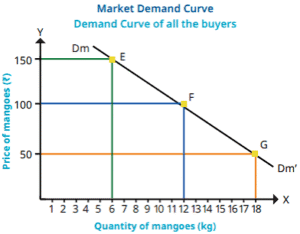
The total amount of mangoes that all possible buyers want to purchase at various prices is referred to as market demand;
In other words, it is the sum of all individual demands.
- The demand in the market refers to the total amount of a product that all the consumers in that market are willing and capable of purchasing at various prices over a certain period.
- That is to say, the total amount of market demand is equal to the sum of the demands of each consumer.
- The table below gives the market demand schedule for three consumers, Alex, Srivalli and Israt.
Market Demand Schedule

- The market demand is obtained by adding the quantities demanded by all three consumers at each price level (Q1 + Q2 + Q3).
- Thus, the market demand is 6 kg at ₹ 150, 12 kg at ₹ 100 and 18 kg at ₹ 50.
- When this market demand schedule is represented graphically, it is called the market demand curve.

The Price Puzzle Class 9 Economics Notes
Diminishing Marginal Utility
First, we need to understand how consumers make purchasing decisions.
The Principle of Diminishing Marginal Utility (DMU) helps us understand this process.
It forms an important basis of demand.
The principle states that a consumer gets less extra satisfaction from each additional unit of the same product.
For example, the first slice of pizza gives a person a lot of satisfaction.
However, the second slice gives less satisfaction.
The third slice gives even less satisfaction.
Therefore, consumers may not want to pay a high price for additional units.
As a result, the quantity demanded generally falls as the price rises.
Determinants of Demand
The price of a product does not determine demand alone. Several other factors also affect the quantity demanded.
For example, a company may launch a new model of a popular smartphone.
Many people may book the phone in advance or stand in long queues to buy it.
They may do so even when the phone has a high price.
Thus, factors other than price can also influence demand.
The important determinants of demand are given below.
Price of Related Goods
First, changes in the prices of related goods can affect demand.
We can divide related goods into two main types.
(i) Substitute Goods
Substitute goods can replace each other because they satisfy the same need.
For example, tea and coffee act as substitutes.
If the price of coffee increases, many consumers may buy more tea.
Therefore, the demand for tea may increase.
(ii) Complementary Goods
Complementary goods work together and satisfy a need together.
For example, printers and printer cartridges are complementary goods.
If more people buy printers, they will also need more cartridges.
Therefore, the demand for printer cartridges increases.
Income of the Consumer
Next, the consumer’s income affects demand. When income increases, consumers can buy more goods and services.
They may also choose better-quality products.
For example, when household income increases, a family may buy more goods or choose higher-quality products.
Taste and Preference of the Buyer
Moreover, consumers’ tastes and preferences affect demand.
These preferences include their likes and dislikes.
For example, a person who likes mangoes may buy mangoes instead of oranges.
This choice may continue even when oranges cost less.
Seasonality
Furthermore, seasonal changes affect demand. Weather conditions, festivals, and the time of the year can change consumer demand.
For example, people need more sweaters during winter.
Therefore, the demand for sweaters increases during the winter season.
Future Price Expectations
Finally, consumers consider future prices before making some purchases.
They may delay or advance their purchases based on their expectations.
For example, many consumers may wait for Diwali or New Year discounts before buying expensive durable goods.
They expect sellers to offer lower prices during these periods.
Supply
Now, let us understand supply.
By definition, supply means the quantity of a product that sellers are willing and able to offer for sale at a given price.
Law of Supply
The Law of Supply explains the relationship between the price of a product and its quantity supplied.
According to this law, producers generally supply more when the price increases.
On the other hand, they supply less when the price decreases.
However, this relationship holds when other factors remain unchanged.
Economists call this condition ceteris paribus, which means “other things remaining the same.”
Therefore, the law of supply shows a direct relationship between price and quantity supplied.
Hence, there is a direct relationship between the price of a product and the quantity supplied

Individual Supply Schedule

Determinants of Supply
The supply of a product depends on more than its price.
Several other factors also affect the quantity that producers are willing to supply.
These factors can change even when the product’s price remains the same.
The main factors affecting supply are given below.
Prices of Other Goods
First, producers consider the prices of other goods that they can produce with the same resources.
If another product gives them higher profits, they may produce more of that product.
As a result, the supply of the original product may decrease.
For example, a farmer may grow chickpeas instead of wheat if chickpeas give higher returns.
Number of Sellers in the Market
Next, the number of sellers affects market supply. When more producers sell a product, the market supply increases.
On the other hand, fewer producers reduce the market supply.
For example, when more firms start producing bottled water, the supply of bottled water increases.
Technology
Moreover, better technology helps producers increase production.
It improves efficiency and reduces production costs. Therefore, producers can supply more goods to the market.
For example, drip irrigation helps farmers grow more crops. As a result, it increases the supply of crops.
Expectations About Future Prices
Finally, producers consider future prices and demand.
Their expectations can affect the quantity they supply today.
If producers expect prices to rise in the future, they may reduce their current supply.
They may store the product and sell it later at a higher price.
For example, a mango wholesaler may store mangoes if they expect prices to increase in the coming weeks.
The Price Puzzle Class 9 Economics Notes
Market Equilibrium
Market equilibrium occurs when the quantity demanded equals the quantity supplied.
At this point, buyers want to buy exactly the amount that sellers want to sell. Therefore, the market has neither a shortage nor a surplus.
As a result, the price usually remains stable. However, outside factors can change the market price.
In every market, buyers and sellers interact with each other. Buyers are willing to pay a certain price.
Similarly, sellers are willing to sell at a certain price.
Thus, the interaction between demand and supply determines the market equilibrium.
The table shows the quantity of mangoes demanded and supplied at different prices.
At a low price, buyers demand more mangoes than sellers supply. Therefore, the market faces excess demand or a shortage.
On the other hand, sellers supply more mangoes when the price is high. Buyers, however, demand less at that price.
Therefore, the market faces excess supply or a surplus.
Finally, the market reaches equilibrium when the quantity demanded becomes equal to the quantity supplied.
Relationship between quantity supplied and quantity demanded

At a price of ₹100, quantity demanded equals quantity supplied.
This point is called market equilibrium. At the equilibrium price, the market is in balance, so the price does not tend to rise or fall.
As a result, there is neither a shortage (excess demand) nor a surplus (excess supply), and all goods produced are successfully bought and sold.
Real-World Deviations
Market equilibrium does not remain constant in the real world.
It depends upon changes in consumer preferences, technology, production costs, government policies, weather, wars, pandemics, and natural disasters, which continuously affect demand and supply.
As a result, the equilibrium price and quantity keep changing, and markets keep adjusting to a new equilibrium.
Real-Life Example: COVID-19 Pandemic
During the COVID-19 pandemic, the demand for face masks and sanitizers increased sharply.
Supply could not increase immediately, leading to shortages and higher prices.
As production expanded, supply increased, prices gradually fell, and the market moved towards a new equilibrium.
After the pandemic, demand declined further, and prices returned close to their pre-pandemic levels. ,
This example shows that market equilibrium is not fixed. Changes in demand and supply continuously create a new equilibrium in real-world markets.
The Price Puzzle Class 9 Economics Notes
Role of Government in the Economy
India is the fourth largest economy in the world and has a market-based, regulated economic system in which prices are mostly determined by demand and supply.
In this type of economy, the government has an important role as follows:
The government makes sure that the market operates fairly and safeguards the interests of both consumers and producers.
It gets involved whenever the markets fail to secure fairness and equity, in particular for vulnerable and low-income groups.
The government will regulate the prices of essential goods and services if it needs to in order to ensure that they remain affordable.
If there is a sharp rise in the prices of essential medicines, the government could set a maximum price so that they are accessible to everyone.
Government Measures to Prevent Unfair Practices
The government takes several important measures to regulate unfair trade practices and protect consumers and producers.
Imposes a Price Ceiling
First, the government fixes a maximum price for essential goods such as medicines, food items, and fuel.
In this way, it prevents sellers from charging excessively high prices and keeps essential goods affordable for consumers.
Prevents Shortages
Moreover, when a price ceiling causes a shortage, the government takes steps to increase the supply of goods.
For example, it uses the public distribution system, allows imports, or encourages producers to increase production.
Thus, the government tries to meet consumer demand and maintain the availability of essential goods.
Controls Black Marketing
Furthermore, the government takes legal action against traders who sell goods above the government-approved price or deliberately hoard goods.
Such traders create artificial shortages to earn higher profits.
Therefore, the government uses laws and penalties to control black marketing and protect consumers.
Fixes a Price Floor
In addition, the government sets a minimum price below which certain goods or services cannot be sold.
As a result, producers and workers receive a fair minimum price or wage. This measure helps protect their income and prevents exploitation.
Regulates Monopolies
Similarly, the government enforces competition laws to prevent a single seller or a few firms from dominating the market.
These laws prevent firms from charging unfair prices, restricting supply, or providing poor-quality goods and services.
Consequently, consumers get better choices and fairer market conditions.
Establishes Regulatory Authorities
Finally, the government establishes regulatory authorities to promote transparency, protect consumers, and regulate different sectors of the economy.
For example, the RBI regulates banking, the CCPA protects consumer rights,
TRAI regulates telecommunications, and SEBI regulates the securities market.
Therefore, these authorities help ensure fair and transparent functioning of different markets.
The Price Puzzle Class 9 Economics Notes
Limitations of Government Intervention
The following are the key measures taken by the government to regulate unfair trade practices.
The government sets a price ceiling by determining the highest price that can be charged for essential items such as medicines, food, and fuel.
This stops sellers from charging very high prices and ensures that these goods remain affordable for consumers.
if a price ceiling results in a shortage, the government can increase the supply of the goods by means of public distribution, imports, or by encouraging
greater production to meet consumer demand.
Excessive regulation and price controls may reduce the incentive to invest in new ideas, better technology, or business expansion.
For example, if farmers cannot earn adequate returns because of price controls, they may not invest in improved seeds, irrigation facilities, or modern
technology, reducing productivity and long-term output.
The Price Puzzle Class 9 Economics Notes
Conclusion:
The Price Puzzle chapter must have helped you understand how prices are determined in a market and why they keep changing according to demand and supply. As a student, you have learned that the price of a product is not decided randomly; it is influenced by consumers, producers, availability, competition, and changes in market conditions. The Price Puzzle notes will also help you understand that when demand increases and supply remains limited, prices may rise, while greater supply can put pressure on prices to fall. These ideas will make it easier for you to understand the prices of everyday goods and services around you. Overall, The Price Puzzle has made economics more practical and interesting by connecting classroom concepts with real-life market situations.
If you want MCQ’s, short, long, and application-based questions, and answers, do write to me in the comment box.



0 Comments