
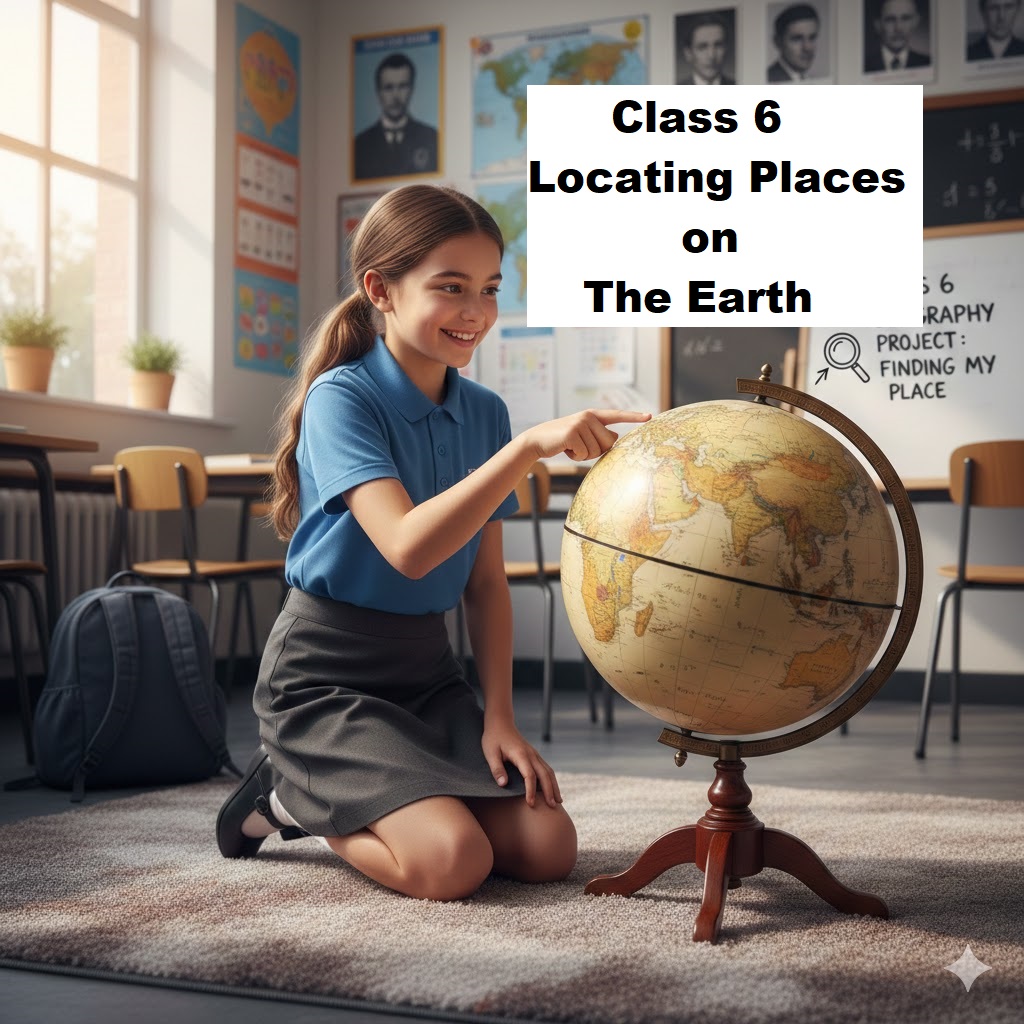

Class 6 New NCERT Social Science Chapter 1 Lesson Plan
Class 6 New NCERT Social Science Month-Wise Lesson Plan is a crucial teaching tool created to assist teachers. It helps in presenting the new curriculum in an organized and interesting way. This lesson plan guarantees seamless classroom implementation of competency-based objectives, With integrating learning strategy and new topics, Social Science teachers require a clear road plan. A well-crafted Class 6 New NCERT Social Science Month-Wise Lesson Plan adheres to CBSE learning objectives and NEP 2020 requirements. It provides a balanced coverage of history, geography, and civics. Moreover, it assists educators in methodically organizing exercises, tests, and practical learning techniques.
In addition to improving classroom engagement, this extensive Class 6 New NCERT Social Science Month-Wise Lesson Plan encourages critical thinking, map skills, discussion-based learning, and student participation for significant academic advancement. So, let’s begin.
Class 6 New NCERT Social Science Chapter 1 Lesson Plan
India and the World: Land and the People
Chapter 1 — Locating Places on the Earth
General Information
Class: VI
Subject: Social Science (Geography)
Chapter: Locating Places on the Earth
Duration: 6–8 Periods (40 minutes each)
Approach: Experiential & Competency-Based Learning
Assessment Type: Formative + Map Skills
1. Objectives
Students will be able to:
Define globe, map, latitudes, and longitudes.
Identify important lines like the Equator and Prime Meridian.
Explain the grid system.
Describe the heat zones of the Earth.
Locate places using coordinates.
Calculate simple time differences.
2. Teaching Aids
Globe
Political & Physical World Map
Atlas
PPT / Smart Board
Blank outline maps
Worksheet (Coordinate practice)
Flash cards (Important lines)
3. Teaching Methodology
Demonstration Method (Globe handling)
Questioning Technique
Map Work Practice
Inquiry-Based Learning
Think–Pair–Share
Activity-Based Learning
4. Teaching-Learning Process
Introduction (5–7 minutes)
Show a globe and ask: “How can we find a place on Earth?”
Connect to real-life example (Google Maps).
Introduce the topic.
Class 6 New NCERT Social Science Chapter 1 Lesson Plan
Chapter 1 — Locating Places on the Earth
5. Development of Lesson
WEEK 1: Globe and Maps
Learning Objectives
Students will be able to:
Define globe and map.
Identify continents and oceans.
Compare globe and map.
Teaching-Learning Process
Introduction: Show globe and ask students what they observe.
Explanation: Explain spherical shape of Earth.
Comparison Activity: Globe vs Map chart on board.
Reinforcement: Quick oral questions.
Activity
Students identify continents & oceans on globe.
Draw rough world map outline.
Assessment
Exit ticket: Write 2 differences between globe & map.
WEEK 2: Latitudes and Longitudes
Learning Objectives
Students will:
Define latitudes & longitudes.
Explain grid system.
Locate simple coordinates.
Teaching Strategy
Draw grid on board.
Demonstrate 0° Equator & 0° Prime Meridian.
Practice coordinate location.
Activity
Students create a simple grid in notebook.
Locate given coordinates (e.g., 20°N, 80°E).
Assessment
Worksheet (Locate 5 places).
WEEK 3: Important Lines of Latitude & Longitude
Key Lines:
Equator
Tropic of Cancer
Tropic of Capricorn
Arctic Circle
Antarctic Circle
Prime Meridian
Learning Outcomes
Students can:
Identify important latitudes.
Explain heat zones.
Locate India in relation to Tropic of Cancer.
Teaching Method
Map marking practice.
Concept of heat zones with diagram.
Activity
Colour different heat zones.
Label major lines on blank map.
Assessment
Map test (Label 6 major lines).
WEEK 4: Time Zones & India’s Location
Learning Objectives
Students will:
Explain concept of time zones.
Calculate simple time differences.
Locate India using latitudes & longitudes.
Teaching Process
Explain rotation of Earth.
Show 360° ÷ 24 hours concept.
Discuss Indian Standard Time (IST).
Locate India on world map.
Activity
Time calculation (If 12 noon in London, what time in India?).
Mark India’s latitudinal & longitudinal extent.
Assessment
Short answer test.
Case-based question.
Map marking.
Class 6 New NCERT Social Science Chapter 1 Lesson Plan
Chapter 1 — Locating Places on the Earth
Learning Outcomes (Competency-Based)
Students will be able to:
✔ Use coordinates to locate places
✔ Interpret world maps
✔ Explain heat zones
✔ Calculate time differences
✔ Locate India accurately
Closure
Rapid-fire questions.
Quick recap through 5 oral questions.
6. Class Work
Draw and label important latitudes.
Practice locating 5 coordinates.
Map marking of Equator, Tropics, Prime Meridian.
7. Home – Work
Draw world map and label 6 major latitudes.
Locate India’s latitudinal & longitudinal extent.
Solve worksheet (Time calculation).
8. Class Activities
Globe Observation Activity
Students identify continents & oceans.
Coordinate Challenge
Teacher gives coordinates; students locate them.
Heat Zone Coloring
Colour torrid, temperate, and frigid zones.
Time Calculation Game
If time in London is 10 AM, what is time in India?
9. Assignments
Project: “Why is India called a Subcontinent?”
Atlas Work: Locate 10 world cities using coordinates.
Short Paragraph Writing: Importance of Prime Meridian.
Class 6 New NCERT Social Science Chapter 1 Lesson Plan
Chapter 1 — Locating Places on the Earth
10. Assessment Strategy
Formative Assessment
Oral questioning
Worksheet
Map labeling
Exit tickets
Summative Assessment
MCQs
Short answer questions
Map work (5 marks)
Case-based question
11. Differentiated Instruction
For Slow Learners:
Provide partially labelled maps.
Extra guided practice.
Peer support groups.
For Advanced Learners:
Research time zones of 5 countries.
Find exact coordinates of capital cities.
12. Learning Outcomes
By the end of the chapter, students will be able to:
✔ Differentiate between globe and map
✔ Identify and label major latitudes and longitudes
✔ Use coordinates to locate places
✔ Explain why India follows IST
✔ Interpret basic world maps accurately
13. Remedial Measures
Re-teach grid system using simplified diagrams.
One-to-one coordinate practice.
Provide additional map worksheets.
Conduct small group revision sessions.
14. Integration with Other Subjects
| Subject | Integration |
|---|---|
| Mathematics | Degree & time calculation |
| ICT | Google Earth demonstration |
| Art | Map coloring |
| English | Paragraph writing |
15. Evaluation Rubric
| Criteria | Excellent | Good | Needs Improvement |
|---|---|---|---|
| Map Skills | Accurate labeling | Minor mistakes | Incorrect |
| Concept Clarity | Clear explanation | Partial clarity | Confused |
| Participation | Active | Moderate | Passive |
16. NEP 2020 Alignment
Experiential Learning (Globe handling)
Competency-Based Assessment
Skill-Based Learning (Map reading)
Critical Thinking (Time zone calculation)
Student-Centered Approach
17. Cross-Curricular Integration
| Subject | Integration |
|---|---|
| Mathematics | Degree calculation & time difference |
| ICT | Google Earth activity |
| Art | Map coloring |
| English | Paragraph writing on “Why is India called a subcontinent?” |
18. Differentiated Instruction
Slow learners: Guided coordinate practice
Advanced learners: Locate 10 world cities using atlas
19. Assessment Plan (Month End)
| Type | Marks |
|---|---|
| MCQs | 5 |
| Short Answers | 5 |
| Map Work | 5 |
| Case-Based | 5 |
| Total | 20 |
Class 6 New NCERT Social Science Chapter 1 Lesson Plan
Chapter 1 — Locating Places on the Earth
Conclusion:
Class 6 New NCERT Social Science Chapter 1 Lesson Plan provides a strong academic resource that aids instructors in presenting geography themes in an organized and interesting manner. Using maps, globes, latitudes, and longitudes, this lesson plan makes sure that “Locating Places on the Earth” is explained clearly. With the help of Class 6 New NCERT Social Science Chapter 1 Lesson Plan, teachers can establish clear learning objectives, employ appropriate teaching aids, and incorporate critical thinking-promoting activities into their lessons.
The Class 6 New NCERT Social Science Chapter 1 Lesson Plan also provides Competency-based education. Moreover, it further supports and incorporates worksheets, remedial activities, and assessment techniques for a variety of learners. It improves classroom management, reduces preparation time, and synchronizes instruction with objectives that are centered on NEP. Most significantly, it gives teachers confidence by offering a methodical framework for instruction, guaranteeing that pupils successfully and meaningfully acquire fundamental geographical knowledge.

0 Comments